
Vendor-neutral substation automation knowledge
Master IEC 61850 and digital substation architecture — built for engineers who commission real systems.
Practical depth that covers the full lifecycle — from architecture design and SCL configuration to on-site commissioning and fault finding. Built by someone who has done both, across GCC and India.
VENDOR-NEUTRAL SUBSTATION AUTOMATION TRAINING
Master IEC 61850 and the IEC 62443 security that has to sit around it — taught by engineers who have designed and commissioned real systems.
We teach the IEC 61850 standards, the substation automation architecture built on them, and the OT security that holds it together. Independent of any vendor.
61850 + 62443
the intersection, not a generic cyber course
5 pillars
standards to good practice
Vendor-neutral
standards and architecture, not products
THE TRAINING GAP
The grid is digital. The workforce isn’t — yet.
Most engineers can configure a relay through one vendor’s tool. Far fewer can trace a GOOSE message end to end, separate station bus from process bus, or explain why a segmentation boundary sits where it does. OEM courses teach products. Academic courses teach theory. The architecture in between is what decides whether a digital substation works.
WHAT CHANGES AFTER TRAINING
-
Read an SCL file and know what the engineering tool did to it
-
Specify station bus and process bus with reasons you can defend
-
Debug MMS, GOOSE and Sampled Values on the wire, not in a GUI
-
Hold your architecture position in a design review with any vendor
-
CURRICULUM PILLERS
Five pillars. One mental model.
Vendor-neutral, architecture-first training that sits between OEM product courses and abstract academic theory.
01
IEC 61850 STANDARDS
Read an SCL file. Trace a GOOSE. Make the bus call.
The data model first — logical nodes, logical devices, datasets — then the services that move it. Leave able to specify station bus against process bus, follow MMS and Sampled Values on the wire, and defend the architecture to any vendor.
-
SCL: SSD, ICD, SCD and the engineering workflow
-
MMS reporting, GOOSE publish-subscribe, Sampled Values
-
Station bus and process bus: what belongs where
02
OT CYBERSECURITY
Place the control. Pass the audit.
Apply the Purdue model to a real substation, align a design to IEC 62443 and IEC 62351, and explain to an auditor why each boundary sits where it does. Availability before confidentiality, on assets that live 15 to 25 years.
03
TIME SYNCHRONISATION
Lock the clock. Migrate without breaking relays.
PTP IEEE 1588 Power Profile end to end, grandmaster redundancy that survives a GPS failure, and IRIG-B migration on a live substation without disturbing existing protection.
04
NETWORKS AND INFRASTRUCTURE
Design the LAN that keeps protection sub-4 ms.
Pick the right switch, split GOOSE and Sampled Values onto separate VLANs with priority that actually holds under load, and size fibre and redundancy for the next fifteen years rather than the next project.
-
Ring, star, PRP and HSR: failure behaviour, not brochures
-
Switch selection, port budgets and fibre planning
05
COMMUNICATION PROTOCOLS
Choose the protocol. Defend the choice.
Where each of IEC 61850, DNP3, Modbus and IEC 60870-5-104 belongs, how gateways translate between them, and how to migrate serial legacy substations to Ethernet without losing visibility.
IEC 61850 MMS
GOOSE
Sampled Values
DNP3
Modbus TCP
IEC 60870-5-104
PRP / HSR
CORPORATE TRAINING
Programmes structured around your team’s project context.
For utilities, EPCs and system integrators running a digital-substation programme — on-site or virtual, calibrated to the gear and the gaps.
01
WHAT WE DELIVER
Vendor-neutral workshops
IEC 61850 architecture, substation network design, OT cybersecurity and communication protocols — pitched to your team’s experience level and the equipment they actually touch.
02
HOW IT WORKS
Scoped to your project
A pre-training assessment identifies where the gaps are. The programme is then built around those gaps and your live project context, not a generic syllabus.
03
WHO IT’S FOR
Utilities, EPCs, integrators
Transmission companies, EPCs and system integrators across the GCC, India, South Asia and internationally — delivered on-site or virtually.
-
WHO SIGNARID IT FOR
Written in your language, not a brochure’s.
Each audience gets the depth and the vocabulary they work in every day.
FEILED AND COMMISIONING
You test GOOSE on the wire and edit SCL at 2 a.m.
Stop learning IEC 61850 through one vendor’s configuration tool. Get the standard itself — logical nodes, datasets, SCL — so you can walk into any panel and know what you are looking at.
IT AND CYBERSECURITY
You know the Purdue model. Now apply it to a 400 kV yard.
Availability before confidentiality. Assets that live 15 to 25 years. Patch windows measured in planned outages. We map IT instincts onto OT constraints without simplifying either side.
PROJECT ENGINEERING
You make the architecture calls others live with.
Process bus or copper. PTP or IRIG-B. Ring, star or PRP. Make the decisions with the confidence of someone who has defended them in a FAT, not read about them in a brochure.
L&D TRANING
You run an upskilling programme.
A vendor-neutral curriculum, delivered on-site or virtually, structured around your team’s project context and not tied to a single vendor’s ecosystem.
WHY SIGNARID
Vendor-neutral, by design.
The curriculum is built on years of hands-on work across the GCC and India — designing IEC 61850 architectures, configuring SCL and IED parameters at the engineering stage, then commissioning those same systems in the field. That full-cycle view shapes every course: what gets covered, how it is sequenced, and where the real failure points are.
We do not sell IED configuration, tool licences or vendor integration. Signarid teaches the standard and the architecture, and nothing on the invoice depends on which product you buy — which is what keeps the training neutral.
Design
IEC 61850 architecture, SCL configuration, IED parameter engineering
Full lifecycle
Design to commissioning, across the GCC and India
Field
On-site commissioning, fault finding and OT network assessments
Telemetry · Bay A
Event log
The training gap
The grid is digital.
The workforce isn’t — yet.
Most engineers can configure a relay. Far fewer can trace a GOOSE message end-to-end, segment station bus from process bus from the enterprise network, or place a firewall where it actually belongs in a substation. Signarid teaches the architecture between those layers.
$293B grid investment
Saudi Arabia’s committed investment in power & grid infrastructure — the largest digital substation rollout the GCC has ever seen.
Dec 2020 Malerkotla
POWERGRID commissioned India’s first fully digital IEC 61850 substation at Malerkotla. The wave is still in its first decade.
Bay ➔ SCADA
From the merging unit and IEDs in the bay to the SCADA server in the control room — the full architectural stack, end to end.
The Signarid difference
OEM courses teach products.
Academia teaches theory.
We teach the architecture in between — the part that decides whether your digital substation actually works.
Curriculum pillars
The grid is digital.
The workforce isn’t — yet.
Most engineers can configure a relay. Far fewer can trace a GOOSE message end-to-end, segment station bus from process bus from the enterprise network, or place a firewall where it actually belongs in a substation. Signarid teaches the architecture between those layers.
Read an SCL file. Trace a GOOSE. Make the bus call.
Leave the course able to specify station bus vs. process bus, debug MMS and Sampled Values on the wire, and defend your architecture choices to any vendor.
Place the firewall. Pass the audit. Protect the bay.
Apply the Purdue Model to a real substation, align a design to NERC CIP and IEC 62351, and explain to auditors exactly why each segmentation boundary sits where it does.
Design the LAN that keeps protection sub-4 ms.
Pick the right switch, split GOOSE and SV onto separate VLANs with priority that actually holds, and size fibre and RAID for the next 15 years — not the next project.
Design the LAN that keeps protection sub-4 ms.
Pick the right switch, split GOOSE and SV onto separate VLANs with priority that actually holds, and size fibre and RAID for the next 15 years — not the next project.
Choose the protocol. Defend the choice.
Deploy PTP IEEE 1588 Power Profile end-to-end, migrate a legacy IRIG-B substation without breaking existing relays, and build GPS grandmaster redundancy that survives a failure.
Choose the protocol. Defend the choice.
Sequence GICSP, CFOT and SecOT+ in the right order, make the IT-to-OT jump without starting from zero, and show up to interviews with the vocabulary hiring managers use.
Corporate training
Programmes structured around
your team’s project context.
For utilities, EPCs and system integrators running a digital-substation programme — on-site or virtual, calibrated to the gear and the gaps.
Vendor-neutral workshops
IEC 61850 architecture, substation network design, OT cybersecurity and communication protocols — pitched to your team’s experience level and the equipment they actually touch.
Scoped to your project
A pre-training assessment identifies where the gaps are. The programme is then built around those gaps and your live project context — not a generic syllabus.
Utilities, EPCs, integrators
Transmission companies, EPCs and system integrators across the GCC, India, South Asia and internationally — delivered on-site or virtually.
Who Signarid is for
Written in your language, not a brochure’s.
Each audience gets the level of depth and the vocabulary they work in every day.
You test GOOSE on the wire and edit SCL at 2 a.m.
Stop learning IEC 61850 through one OEM’s configuration tool. Get the standard itself — logical nodes, datasets, SCL — so you can walk into any vendor’s panel and know what you’re looking at.
You know the Purdue Model. Now apply it to a 400 kV yard.
Availability before confidentiality. Assets that live 15–25 years. Patch windows measured in planned outages. Signarid maps your IT instincts onto OT constraints without dumbing either side down.
Design the LAN that keeps protection sub-4 ms.
Process bus or copper. PTP or IRIG-B. Ring, star, or PRP. Make the architecture calls with the confidence of someone who’s defended them in a FAT, not read about them in a brochure.
You’re running a digital-substation upskilling programme.
A vendor-neutral curriculum, delivered on-site or virtually, structured around your team’s project context — not a generic syllabus and not tied to a single OEM’s ecosystem.
Why Signarid
Vendor-neutral, by design.
The curriculum is built on 16 years of hands-on work across GCC and India — designing IEC 61850 architectures, configuring SCL and IED parameters at the engineering stage, and then commissioning those same systems in the field. That full-cycle perspective shapes every course: what gets covered, how it is sequenced, and where the real failure points are.
Design
IEC 61850 architecture · SCL configuration · IED parameter engineering
16 Years
Full design-to-commissioning lifecycle across GCC and India
Field
On-site commissioning, fault finding, and OT network security assessments
From the blog
Practical, diagram-heavy posts engineers bookmark.
Short, honest articles on IEC 61850, SCADA, cybersecurity, and substation infrastructure — written for working engineers, not academic audiences.
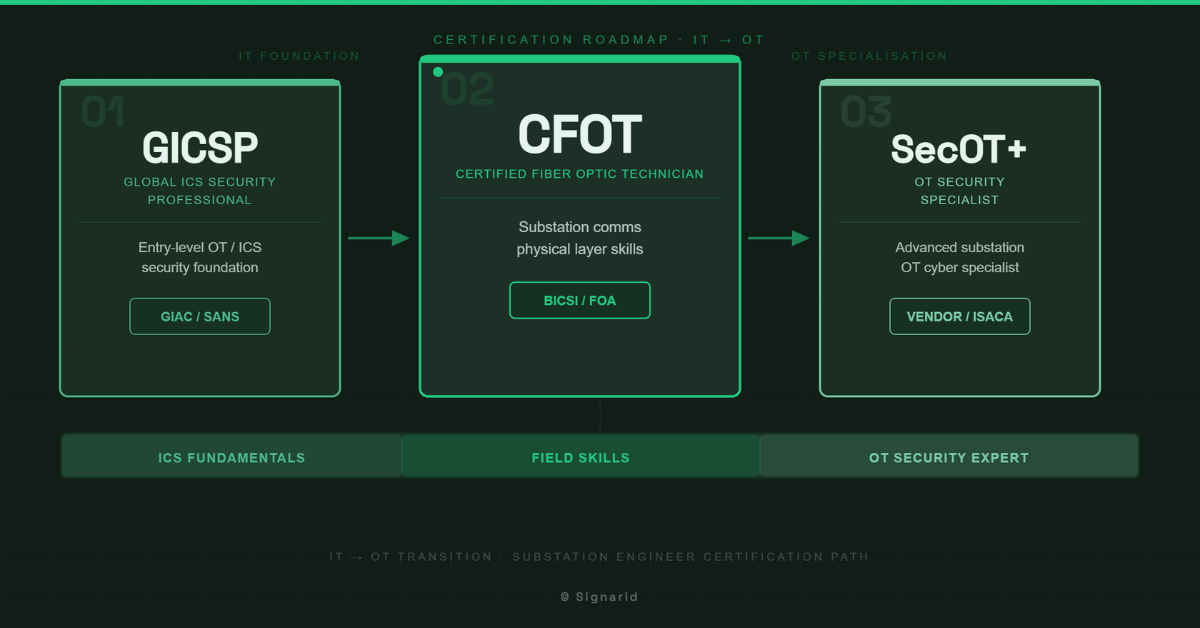
IT to OT Transition for Substation Engineers: The Right Certification Order
The IT to OT transition into a substation environment is not a…
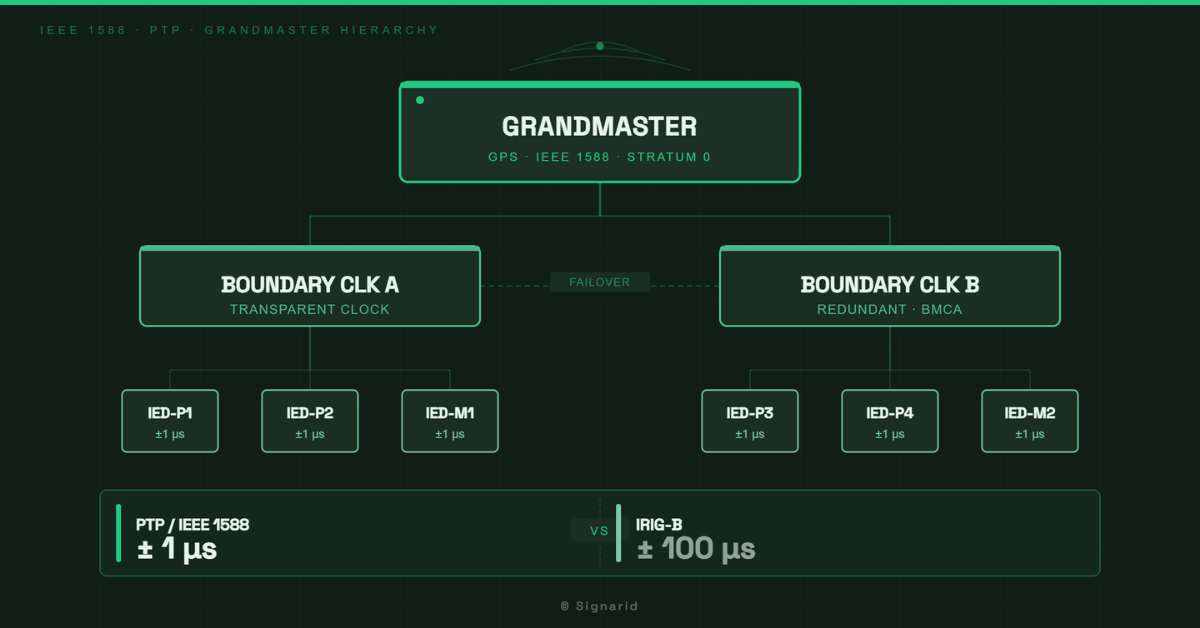
PTP IEEE 1588 in Substations: Time Synchronisation, Grandmaster Redundancy, and IRIG-B Migration
PTP IEEE 1588 is the time synchronisation standard that makes process bus…
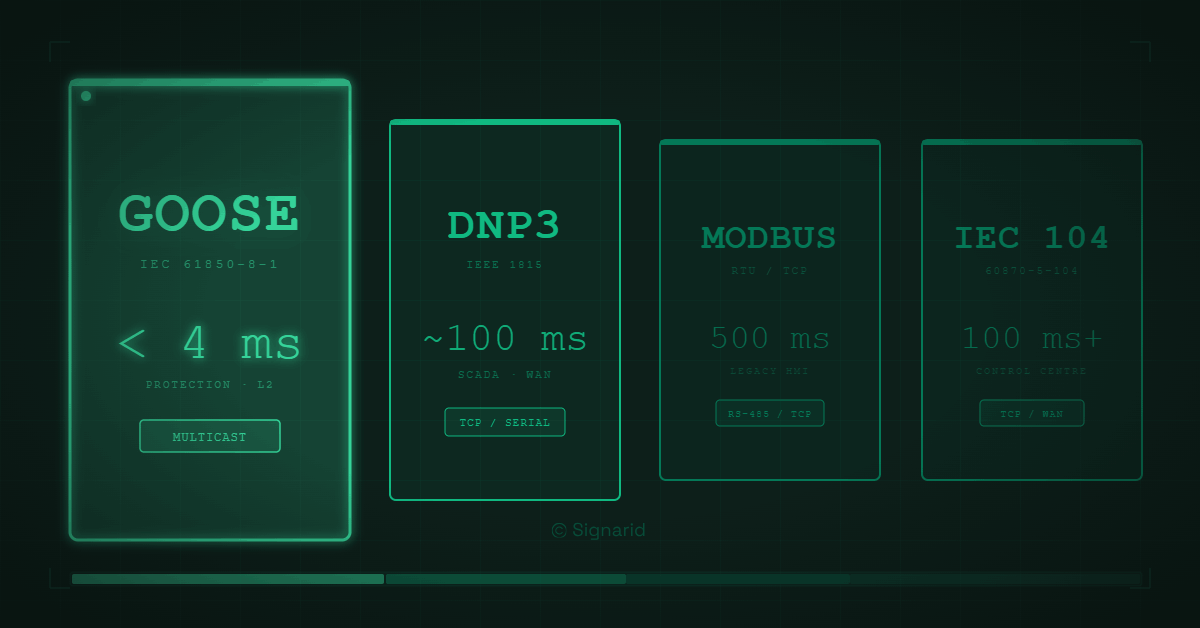
GOOSE Protocol in the Substation: When to Use GOOSE, DNP3, Modbus, and IEC 104
GOOSE protocol questions come up on every multi-vendor substation project — usually…
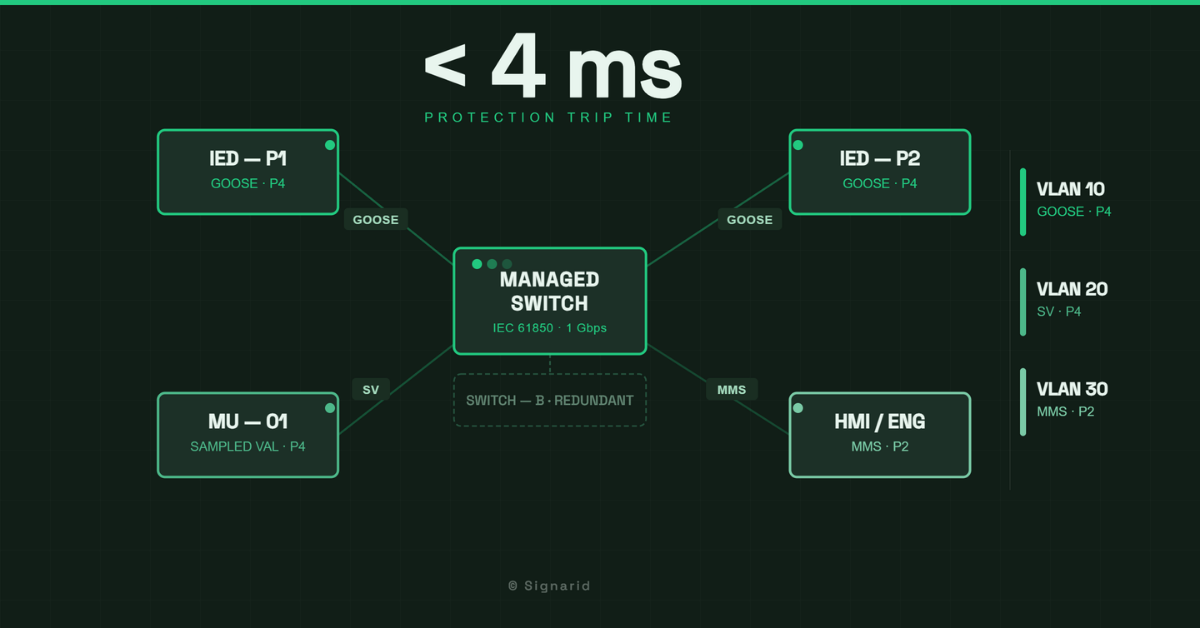
Substation Network Design for IEC 61850: Getting to Sub-4ms Protection
Substation network design for IEC 61850 is not an IT networking problem…
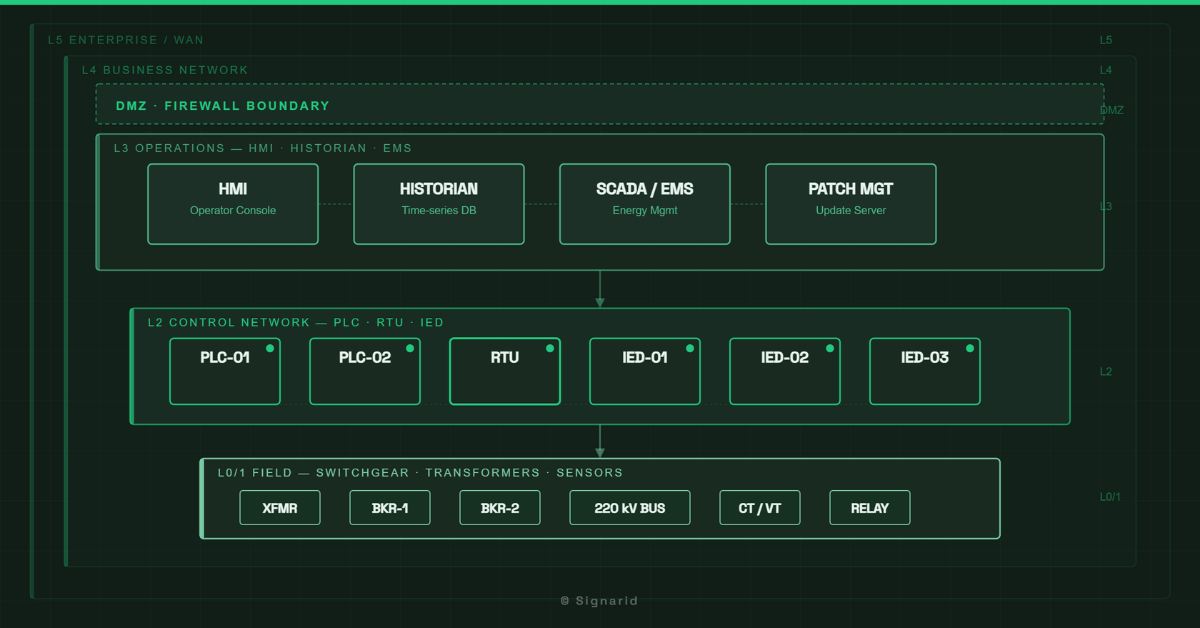
Substation OT Cybersecurity: Where Controls Actually Belong in a Live Switchyard
Substation OT cybersecurity is a discipline that borrows the language of IT…
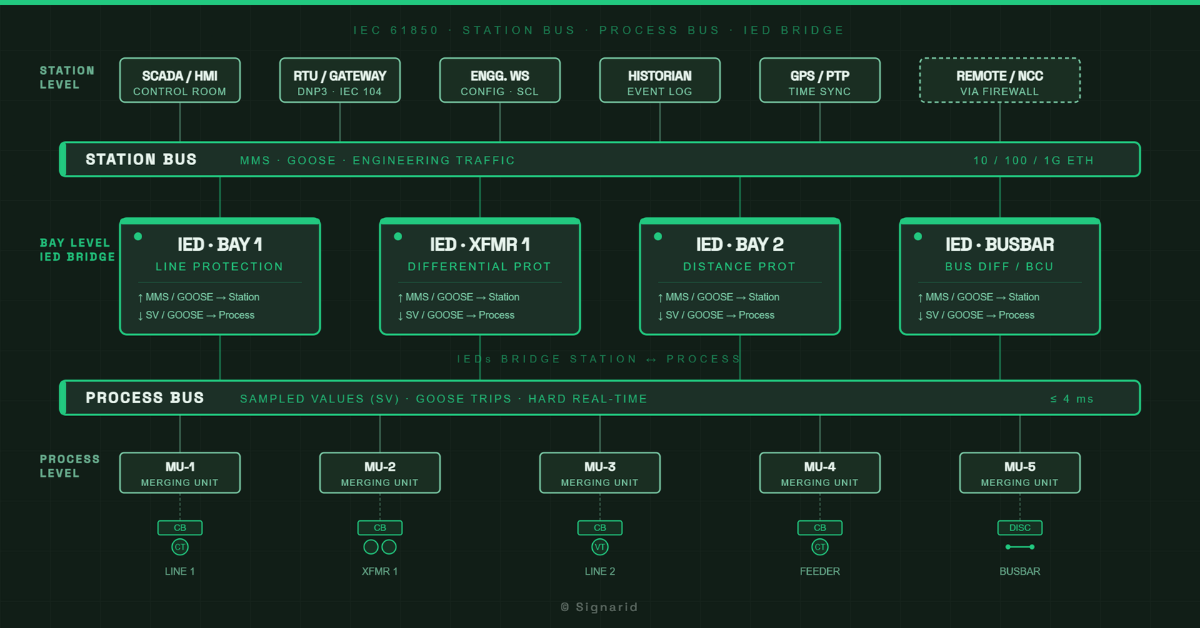
Station Bus vs. Process Bus: How to Make the Right Architecture Call
The station bus vs. process bus decision comes up on every IEC…
-
FROM THE BLOG
Practical, diagram-heavy posts engineers bookmark.
Short articles on IEC 61850, SCADA, cybersecurity and substation infrastructure — written for working engineers.
-
COMMON QUESTIONS
IEC 61850 training, answered plainly.
IEC 61850 is the international standard for communication networks and systems in substations. It defines a common data model for substation equipment and the services — MMS, GOOSE and Sampled Values — that let protection and control devices from different vendors exchange information over one Ethernet network.
No. Signarid teaches the standard itself and the architecture around it. Courses cover logical nodes, datasets and SCL, network and time-synchronisation design, and OT cybersecurity, so engineers can work with any vendor’s equipment and configuration tools.
Protection and commissioning engineers, substation design and project engineers, SCADA and OT teams, and IT or cybersecurity staff moving into operational technology. Programmes are delivered to utilities, EPCs and system integrators.
The station bus carries MMS client-server traffic and GOOSE between bay-level devices and the station level. The process bus carries Sampled Values and GOOSE between primary equipment interfaces — merging units and switchgear I/O — and protection devices, and depends on accurate time synchronisation.
Yes. Programmes run on-site or virtually, and are scoped after a pre-training assessment so the content matches the team’s experience level and the equipment on their live project.